The Porsche Carrera GT turned 25 last year, and we saw the biggest gathering of CGTs back in November at Icons of Porsche, just over a month ago. With its evocative-sounding V10 and three-pedal setup, is widely regarded today as the ultimate analog supercar. But why? Because think about it: What other car offers an engine with F1 roots in a mid-engine format, sends power to the rear wheels, and pairs it all with a manual transmission?
The successor to the CGT, the 918 Spyder was faster, more advanced, and undeniably brilliant, but crucially, it went down the hybrid and automatic route. That shift made one thing clear: it was the end of the line for Porsche’s most uncompromising analog halo car.
As a result, values of low-mileage Carrera GT examples have surged to levels that place them out of reach for most enthusiasts. So it begs the question: which other modern-day Porsche comes closest, if you are looking for that same magical formula that defined the Carrera GT?
So the search moves down the range, guided by a few of those aforementioned non-negotiables. Mid-engine, rear-wheel drive, natural aspiration, and a stick. Apply those filters across Porsche’s modern lineup, and you have some pretty limited choices that fit that criterion.
Power-to-weight ratio is also a big part of this story. Within the Cayman and Boxster lineage, spanning the 986, 987, and 982 generations, nothing quite matches the Carrera GT’s figure. The CGT produces 605 horsepower and weighs approximately 3,040 pounds, resulting in a specific power output of about 5.1 pounds per horsepower. That is the magic number, and it remains untouched by any mid-engine Porsche that followed.
Yes, if you broaden the scope to include 911s, certain GT3 RS models, perhaps come close, but they abandon the mid-engine layout that is central to this discussion. Once that is removed from the equation, the answer becomes obvious.

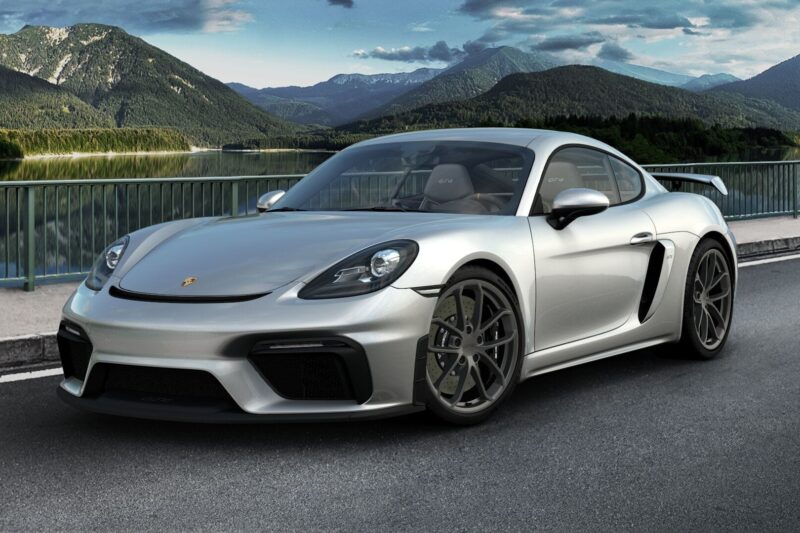
The closest mid-engine Porsche that still respects the underlying philosophy is the Porsche 718 Cayman GT4. Produced between 2019 and 2025 as part of the 982 generation, the GT4 packs a naturally aspirated 4.0-liter flat-six that produces 414 horsepower. Early models were offered exclusively with a 6-speed manual, but a 7-speed PDK was subsequently offered with power going exclusively to the rear wheels.
Our focus is on the manual here. At approximately 3,200 pounds, its power-to-weight ratio sits around 7.7 pounds per horsepower. On paper, that gap is significant to the CGT. It is also worth noting that the 981 GT4 featured a 3.8-liter engine, and the more potent GT4 RS is PDK-only.
Having said that, where the two cars truly align is in engagement. The 982 GT4 isnot a successor to the Carrera GT in performance, and nor does it pretend to be a halo car. But what it offers is philosophical continuity, and its far more compact dimensions make it a properly usable sports car in the real world.
Like the CGT, it prioritizes throttle response, revs, balance, and driver commitment over outright speed. The mid-engine layout should deliver the same sense of rotation and precision that defined the Carrera GT, even if the materials and scale are different.


Also, sound is another part of the conversation, and it truly matters. Yes, the Cayman GT4 will never sound as otherworldly as the Carrera GT’s high-revving 5.7-liter V10, and it should not be expected to. But that does not mean the 4.0-liter flat-six lacks drama. Far from it, because unlike a 911, where the engine lives behind you, the Cayman’s powerplant sits inside the cabin, just inches from your ears. The result is a raw, mechanical soundtrack that builds with revs and feels intimate, immersive, and deeply connected to the act of driving.
Coming to value and attainability, the contrast between these two cars couldn’t be more different. Just 1,270 examples of the Carrera GT were produced globally, and today pricing routinely sits well into the seven-figure range (~$2.0+ million), placing it firmly beyond the reach of anyone who is not a serious collector. It exists now as a reference point rather than a realistic aspiration.

By contrast, the 982-generation 718 Cayman GT4, whose production ended in October 2025, was produced in far greater numbers and remains realistically attainable, with original pricing hovering around the low six-figure mark and current market values still within reach for committed enthusiasts today. It is worth noting that you can still get a manual-rear-drive mid-engine Cayman/Boxster in GTS 4.0 guise, but it’s not as track-focused or as powerful as the GT4.
In conclusion, while the Cayman GT4 may never carry the mystique or financial gravity of the Carrera GT, that is precisely the point. But if you want the closest attainable expression of that mid-engine, manual, naturally aspirated philosophy today, built to be driven rather than stored in a climate-controlled garage, the 718 Cayman GT4 is likely your closest choice. We’ve barely scratched the surface on what makes the Cayman GT4 so appealing. You can investigate several other reasons here.
Images: Porsche