The next-generation BMW M3, internally coded ZA0, will arrive in 2027 with perhaps the most radical drivetrain BMW M has ever produced. During a technical workshop back in November 2025, BMW engineers revealed that the electric M3—part of the broader M Neue Klasse lineup—will feature four independent electric motors, one per wheel, with no mechanical differentials whatsoever. It’s an approach that represents both enormous potential and a new engineering approach for a nameplate that has defined the sport sedan segment for four decades.
The Foundation: Understanding the Standard iX3 Drivetrain

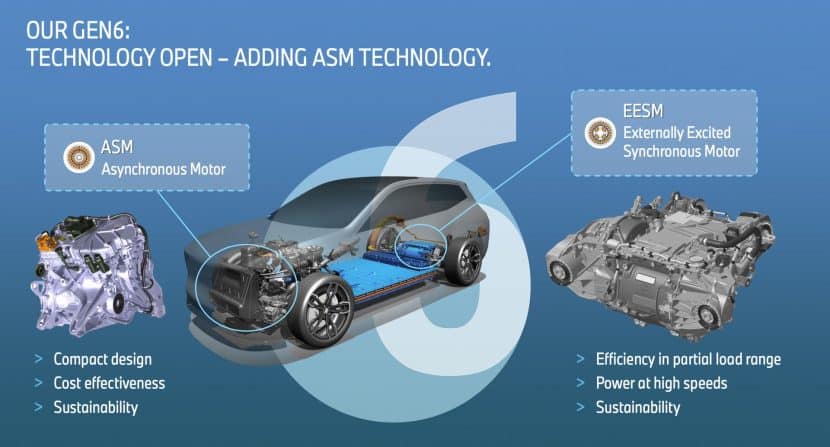
Before diving into the M3, it’s important to understand the baseline Gen6 batteries and motors that the M variant will build upon. Philip Guerrero, BMW’s Gen6 battery project lead, walked journalists through the standard iX3 configuration during the workshop, providing specific technical details that have been notably absent from press releases. The standard iX3 uses a two-motor setup:
- Rear axle: EESM (Externally Excited Synchronous Motor) producing 240 kW
- Front axle: ASM (Asynchronous Motor) producing 123 kW
- Combined system output: 345 kW (462 hp)
According to Guerrero, “On the rear axis, we have an EESM, an externally excited synchronous motor which is highly efficient, delivers high power at high speeds, is sustainable and ideal for the rear axis, which is the primary axis to drive. And on the front we have an ASM on the secondary axle, which is perfect for supporting if you need more power, with really compact design, it’s cost efficient and also optimized for weight.”
The battery pack delivers 108.7 kWh usable capacity (112 kWh gross), enabling 805 kilometers of range—330 km more than the current iX3. The system supports 400 kW DC fast charging and achieves 15.1 kWh/100km efficiency. Compared to Gen5 technology, the Gen6 drivetrain shows 40% reduced losses, 10% weight reduction, and 20% lower manufacturing costs. That’s the baseline. Now here’s where it gets interesting for the M3.
Four Motors, Four Wheels, Zero Mechanical Links

The M eDrive system doubles the motor count to four, with one motor per wheel. But it’s not simply adding two more motors—it’s a complete rethinking of the architecture. During the workshop, Philipp Brunn, Head of Project BMW M Neue Klasse, explained the configuration:
“It’s one big single housing” per axle, he confirmed, with “two motors in parallel, each delivering power to one gearbox per wheel.” When asked directly if there were mechanical links between wheels, the answer was unequivocal: “No, it’s complete. All wheels are completely separate.”
This means:
- No mechanical differentials (front, center, or rear)
- No torque-splitting gears between left and right wheels
- No mechanical connection between wheels at all
- Individual gearbox per wheel for independent control

When pressed about motor type—specifically whether all four use permanent magnet technology—the engineers declined to specify, saying only “we’re not talking about the technology [at the moment.]” This suggests BMW may be using different motor types front-to-rear, possibly permanent magnet motors for maximum power density, though this remains unconfirmed.
The front and rear drive units are “a little different” but use “common parts,” according to Brunn. The hardware is designed for maximum modularity while maintaining the individual wheel control that’s central to the M Dynamic Performance Control system.
Why BMW Chose This Architecture

BMW’s engineers were candid about their decision-making process. “We looked at all kinds of possibilities, and then we went for this, because you can control each wheel individually fast as you like, so it gives you the maximum freedom,” Brunn explained. “Our control engineers, they love it, because they can do whatever they want to do.”
That freedom matters because it addresses a fundamental problem with other multi-motor electric vehicles. During the Q&A session, one journalist noted: “Every four motor system that I’ve had a chance to drive, or even tri motor system in the rear, you get weird wheel flares, and sometimes there’s some lag between transferring torque.”
That lag—the delay when torque shifts from one wheel to another—disrupts the natural flow that makes a great sports car. It’s why most performance cars still use mechanical differentials despite their weight and complexity. The question BMW is trying to answer: can software respond fast enough to eliminate that lag entirely?
The Software Challenge: Can You Really Simulate a Mechanical Differential?

When asked directly whether BMW believes it can simulate a mechanical differential through software to make the car drive naturally, Brunn’s response was measured: “I wouldn’t say how we’re doing it, but with the targets we set for ourselves, it’s the idea to be able to have a car that’s like, you know, BMW M is predictable. It’s controllable. It does the things always the same when you’re track driving. The DSC helps you if you use it, but you can still get power going and it’s putting that on a new level.”
That emphasis on predictability and consistency is telling. The best M3s aren’t just fast—they’re repeatable. The car does the same thing every lap. The limits are clear. Skilled drivers are rewarded. That’s harder to achieve with software-controlled torque vectoring than with a mechanical limited-slip differential that responds purely to mechanical forces.
BMW is using one of the Neue Klasse‘s four “Superbrains”—specifically the “Heart of Joy” high-performance computer—to handle all driving dynamics functions. The centralized architecture should enable faster processing than distributed systems, but the proof will be in the driving experience, not the spec sheet.
M Dynamic Performance Control: The Key Technology

The four-motor hardware enables BMW M Dynamic Performance Control, which replaces the mechanical limited-slip differential that has been central to M3 performance since the E30. According to BMW’s official presentation, the system provides:
- Precise control of torque and power at each individual wheel
- Optimal traction right up to the limit
- Continuous torque distribution between braking system and electric motors
- Brake energy recuperation at the limit
- Maximum recuperation efficiency
The system can modulate each wheel independently at extremely high speeds, theoretically eliminating the lag that has plagued other torque vectoring systems. Whether “extremely high speeds” is fast enough to feel natural remains the critical unknown.
Still a Proper RWD M3 (When You Want It)

One detail from the workshop should reassure M3 purists: the front axle can be completely disconnected. And critically, as one engineer confirmed, “that’s a mechanical connection, not an electrical disconnect.”
There’s a physical clutch that decouples the front motors entirely. When engaged, the car becomes a true rear-wheel-drive vehicle with classic M3 handling characteristics. As the engineers noted, this “helps to get rear wheel drive, drift mode in rear wheel drive, all kinds of things you could imagine.”
This isn’t just about enabling drift mode, according to BMW—though that’s part of it. It’s about preserving the rear-drive character that has defined every M3 since 1986. When you disconnect the front axle, you get the willing front end, communicative rear, and throttle-adjustable balance that M3s are known for.
The mechanical disconnect also eliminates drag losses from spinning front motors during highway cruising, improving efficiency and extending range. In theory, it’s a simple solution to a problem many AWD electric vehicles face. But we can’t wait to test it in the real world.
Design to Power: The M3’s Track-Ready Battery

Perhaps the most revealing part of the workshop came when Guerrero explained how BMW adapted the Gen6 battery for M applications. The company showed side-by-side comparisons of the standard iX3 battery cell (“designed to energy”) versus the M variant (“designed to power”).
“We adapted it for BMW M by designing the cell for power purposes,” Guerrero explained. “On the left you see the BMW cell of the iX3, which is designed to energy. And on the right side, you see the very same cell. It looks the same from the outside, by just reducing the internal resistance, we were able to get more power out of the cell, a so called design to power cell.”
The cells are identical externally—same 46mm diameter, same 95mm height, same supplier, same housing. But the internal chemistry is optimized for high power discharge rates rather than maximum energy density. “We’re just doing it by making smaller changes, and the rest as the chemistry and all that is identical,” Guerrero noted.
One journalist questioned why BMW doesn’t just use the Design to Power cells in all vehicles, suggesting they offer “more power and more range.” The response clarified the tradeoff: “I don’t think more range, high range. So I think it’s low range clearly, because of the internal resistance.”
Lower internal resistance enables higher power output but reduces overall energy capacity. The M3 sacrifices some range for the sustained high-power delivery needed for track driving. According to BMW, this approach enables “more power, high range, and racetrack capability” compared to the standard energy-optimized cells.
The battery will still offer over 100 kWh of usable capacity—BMW hasn’t specified the exact figure for M models—with 800-volt architecture for fast charging. Cooling systems and the Energy Master (BMW’s intelligent battery management system) have been optimized for higher power outputs.
Gen6 Platform: Cell-to-Pack Architecture
The M3’s battery benefits from BMW’s Gen6 cell-to-pack architecture, which eliminates the module structure used in current i4, i5, and i7 models. Instead of placing cells in modules and then placing modules in the housing, Gen6 places cylindrical cells directly into the housing in rows.
As Guerrero explained: “We directly put the cells, cell next to each other, cell to cell to cell to cell in rows into the housing of the battery. With that, we save a lot of material that we don’t use, that doesn’t contain energy, and with that, we can reach really high energy density on pack level. And it has also cost and weight advantages in total.”
The architecture is highly scalable. “The cool thing about our concept is that we can easily scale it by adding rows of cells or leaving them out in the same housing,” Guerrero noted. “With that, you can realize different energy levels.”
The housing uses a “pack-to-open-body” concept, mounting directly underneath the vehicle with no bottom plate. “If you don’t have the battery inside of the car, and you look through the car, you see the floor basically directly,” Guerrero explained. The seats mount directly on top of the battery, lowering the center of gravity and reducing overall vehicle height.
Importantly, the battery housing serves as a structural element, connecting front and rear subframes. This increases chassis rigidity, which should benefit handling precision—assuming the software can take advantage of that stiffness.
Made in Garching: BMW’s Vertical Integration
During the workshop, BMW repeatedly emphasized its in-house development capabilities. Guerrero noted that “this Energy Master is produced by BMW in house, and it has been developed in house. The battery cells, we develop them together with our partners. And the battery itself is completely self developed by BMW and also produced by BMW in house. And also the software of the overall pack is also done by BMW by ourselves.”
The M eDrive motors are designed and integrated by BMW M in Garching—BMW’s high-performance headquarters. As Brunn noted, “Our BMW M eDrive stands for innovation and high end technology made in Garching.”
Natural Fiber Reinforcements: Carbon Performance, Lower Emissions

BMW confirmed that all future electric M models will use natural fiber composite materials—a first for M production vehicles. “We’re proud to confirm that we’re using this natural fiber elements on all the fully electric BMW M models in future,” Brunn stated.
When asked if this was BMW-specific material, the response confirmed: “It’s something that’s, let’s say, from how we’re using it, it’s something we’re doing specifically for us. So you wouldn’t be able to go somewhere and buy it exactly in that specification.”
BMW has used natural fibers in motorsport since 2019, gaining experience with durability and production. The material offers similar properties to carbon fiber but can be produced with approximately 40% less CO2 emissions—supporting both performance and sustainability goals.
The Driving Experience: “Insane” Performance

Brunn, who has driven the M prototypes, was enthusiastic about the results: “I’ve been lucky to drive the prototypes some weeks ago, and the performance is, when I get out, I’m smiling, and it’s, I think our boss said it’s insane.”
That’s encouraging, but engineering prototypes driven by people who built the car are one thing. Production vehicles in the hands of customers who’ve owned three previous M3s are another. The critical question remains whether the software can deliver the predictability, consistency, and natural feel that separates great M cars from merely fast ones.
BMW M CEO Franciscus van Meel promises the electric M3 will “establish a new benchmark in the high-performance vehicle segment.” The hardware foundation exists. Whether the software can make good on that promise will determine if the electric M3 becomes a genuine breakthrough or just another fast EV with an M badge.
We’ll find out in 2027.
What We Still Don’t Know
Despite the detailed workshop presentation, BMW left several key questions unanswered:
- Total M3 system power output (standard iX3: 345 kW; expect significantly more)
- Individual motor power ratings per wheel
- Motor type (permanent magnet vs. other technologies)
- Exact M3 battery capacity (over 100 kWh usable, but how much?)
- Vehicle weight (Gen6 is 10% lighter than Gen5, but EVs are still heavy)
- Range with Design to Power cells
- M3-specific charging speeds
- Number of cells in the M3 battery pack (Guerrero declined to answer)
- Pricing (current M3 Competition: $77,195; electric will be significantly more)
Those details will come closer to launch. For now, BMW is focused on the technology story and the promise of breakthrough performance.
Key Technical Specifications
M3 Electric Architecture:
- Drivetrain: Four independent electric motors (one per wheel)
- Configuration: Two drive units (front/rear), each housing two motors
- Gearboxes: Individual gearbox per wheel
- Differentials: None—all torque control via software
- Battery: Over 100 kWh usable, Design to Power specification
- Cell Type: 46mm x 95mm cylindrical, NMC chemistry, reduced internal resistance
- Architecture: 800-volt system
- Platform: Gen6 Neue Klasse with cell-to-pack design
- Front Axle: Mechanical disconnect for true RWD mode
- Control: M Dynamic Performance Control via Heart of Joy computer
- Materials: Natural fiber composites (40% less CO2 than carbon fiber)
- Development: Made in Garching by BMW M GmbH
- Launch: 2027 as part of M Neue Klasse lineup