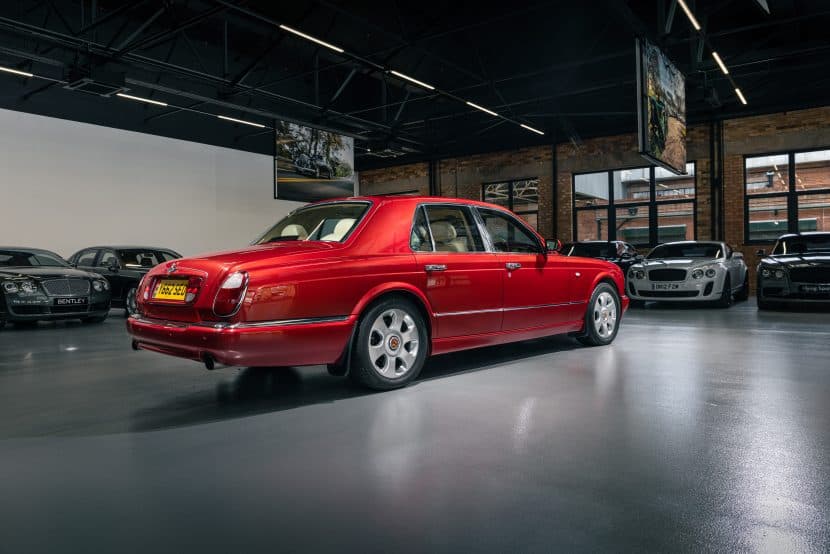
BMW engines have a habit of turning up where you least expect them. After all, you wouldn’t guess that obscure cars like those from Morgan would tout BMW-sourced powertrains, but here we are. The list is long and interesting, too; you can find BMW mills under the hood of Land Rovers, INEOS trucks, the Toyota Supra, and even the legendary McLaren F1. But you probably are already familiar with all, or at least most, of those. You might not remember (or know about) one extremely underappreciated collaboration: Bentley. The Bentley Arnage originally relied on BMW power to get around. Today, it stands the test of time better than you might expect.
The Bentley Powered by a BMW V8: The Arnage
The Bentley Arnage debuted in 1998 alongside its platform mate, the Rolls-Royce Silver Seraph. Mind you, this was well before VW and BMW took ownership of each respective brand. BMW mills would eventually power all Rolls models, and the Silver Seraph kicked the new era off, donning the M73 V12 engine. Far more intriguing was the fact that the Bentley Arnage also received a BMW mill, rather than the 6.75-liter V8 found in nearly every Rolls and Bentley preceding it. Underneath the hood of the first Bentley Arnage was a BMW twin-turbocharged 4.4-liter V8.
While that doesn’t sound so exotic at first — after all, BMW uses twin-turbo 4.4-liter V8s to this very day — we’ve buried the lede a little bit. The power plant powering the early Arnage was none other than the M62 V8, which was only ever utilized as a naturally aspirated engine. Even in cars as exotic as the ALPINA Roadster V8, the M62 remained free of turbochargers. BMW didn’t even add turbos when it came time to develop a high-output version of the M62 — the legendary S62 engine. As it happens, the Bentley Arnage’s M62 got a little bit of therapy from historic British tuning house Cosworth — less of a coincidence when you realize that Bentley’s parent company, Vickers, owned both subsidiaries. The finished product debuted with 350 horsepower and 413 pound-feet of torque, far more power than any BMW M62 variant at the time.
Saying Goodbye With the Green Label

While a seriously impressive engine, the M62-powered Bentley Arnage was not long for the world. Bentley produced only 1,123 examples before switching back to the familiar 6.75-liter unit. Bentley claims the shift was due to customer demand — not impossible. But it was also a product of the ongoing war between VW and BMW over Rolls-Royce/Bentley ownership, a battle which began around the same time the Arnage launched. The switch in powertrains came in 2000, and Bentley bid farewell to BMW with the Bentley Arnage Green Label. The new, 6.75-liter car was given the Red Label moniker.
Only a handful of Green Labels were ever produced, with sources citing as few as 7 coming to market aside from the 52 special editions built as the Bentley Arnage 4.4L Birkin or “Birkin Arnage.” The Arnage Green Label featured the improvements Bentley brought to the Red Label. Most notably, those included a stiffer suspension and bigger brakes, while retaining the car’s BMW heart. The Green Label retained its five-speed ZF transmission. Bentley chose a GM four-speed transmission to replace it in the Red Label.
The sole BMW-powered Bentley is an interesting story over 25 years later. Arguably, the Green Label was the best Arnage produced; the 4.4-liter was more fuel efficient and weighed less, and thanks to the engine’s markedly higher production volume, considerably easier and cheaper to maintain. Today, these BMW-powered Bentleys can be had for around 10% of their original MSRP, which hovered around $215,000. Not bad for what’s unquestionably one of the more interesting highlights of both BMW and Bentley history.