Article Summary
- Auto Express’s interview with BMW vehicle dynamics chief Christian Karg reveals the M3 ZA0’s quad-motor platform can theoretically hit 1,341bhp.
- We expect the production car to land at 800-850 HP, above Auto Express’s own 650-750bhp guess and well below the 1,000bhp-plus rumors.
- The platform’s extra headroom will likely be saved for a future CS or CSL version rather than used on the standard launch car.
Auto Express sat down with Christian Karg, the man who now oversees vehicle dynamics for the entire BMW Group, and walked away with a headline figure: the electric M3’s quad-motor platform can theoretically produce up to 1,341bhp. That number has been bouncing around the internet for months in one form or another, sometimes dressed up as “1 megawatt,” sometimes flattened to a round 1,000 hp. We’ve said all along that BMW won’t launch the M3 ZA0 anywhere near that ceiling. Karg’s own comments back that up, and we still think the real number sits at 800 to 850 hp.
“It’s not about the horsepower,” Karg said. The preciseness of how an M car responds, he said, is what actually separates it from the competition, and chasing the same spec-sheet flex as Chinese rivals isn’t the game BMW M is interested in playing. Karg also talked about the unglamorous side of EV performance: keeping output high as the battery depletes, managing curb weight, and making a car that’s heavier than any M3 before it still feel light on its feet. BMW tests every M car at the Nürburgring specifically because that’s where those problems show up first.
Why We Never Bought The Four-Digit Number

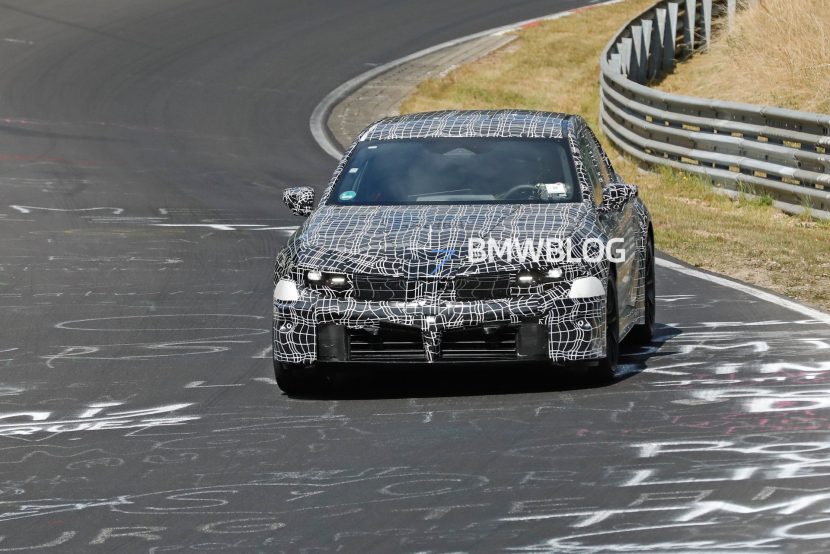
Camouflaged ZA0 prototypes have been spotted everywhere from the Arctic Circle to the Nordschleife, and every sighting seems to come with a fresh round of speculation. Some outlets have floated numbers as high as 1,500bhp for the production car, treating the platform’s theoretical ceiling as if it were the launch spec.
That’s not how BMW M operates. Look at the XM: it didn’t open at 738 hp. That figure belongs to the Label Red, a special edition that arrived well after the standard car, built specifically to use power the platform had been capable of all along. We’d expect the same pattern with the ZA0. The quad-motor setup giving it up to 1,341bhp on paper tells you what the architecture can eventually do, not what BMW intends to ship in year one.
A quad-motor architecture with that much headroom is practically begging for a CS version a few years down the line, and we’d bet that BMW will eventually offer one.
Our Number: 800 to 850 hp

Auto Express settled on 650 to 750bhp for the production car, reasoning that BMW’s torque-vectoring control across four motors will make the car feel quicker than its output suggests. We think that’s a touch conservative. For several reasons, one of them is the fact that a future i3 M60 will deliver at least 630 horsepower
So far, everything we’ve heard about the ZA0, including the dedicated battery pack with more than 100 kWh of usable capacity and the four motors with disengageable front units for a proper rear-wheel-drive mode, points to a car built to sustain serious output, not just produce a big peak number for a few seconds.
Sustaining it is the actual challenge, and Karg said as much. Mercedes-AMG already solved a version of this problem on the new GT 4-Door, using a Formula 1-derived battery pack to keep output from sagging as the car runs down. BMW M will need an answer to that if the ZA0 is going to hold its power on a full Nürburgring lap rather than just a drag strip launch.
It’s The M3, Not The iM3

One thing doesn’t need any hedging. Despite the EV naming convention BMW uses on the iX3 and i3, the production car will simply be called the M3. No “i” prefix, no sub-brand. Given how much of Karg’s answer to Auto Express was about preserving what makes an M car feel like an M car, keeping the name unchanged tracks with everything else he said. BMW M CEO Frank Van Meel also said in the past that he doesn’t want to differentiate between the M3 architectures because in the end, it’s still an M3.