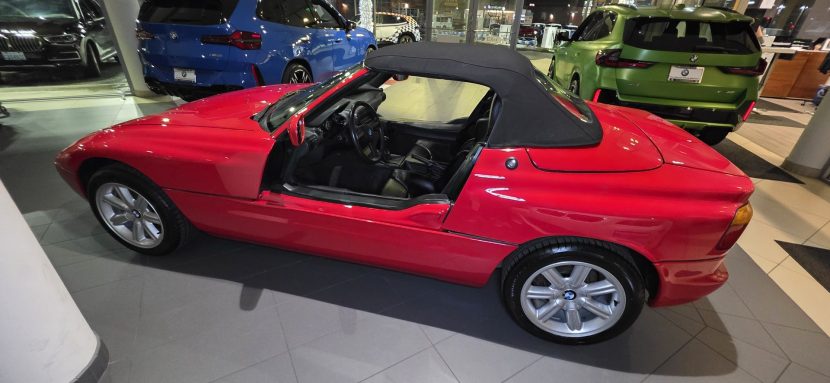
A BMW Z1 has arrived at Spokane BMW, an unusual occurrence that speaks to broader questions about how modern dealerships engage with automotive history. The Z1 represents a moment in BMW’s past worth examining. Conceived in the mid-1980s by BMW Technik GmbH as an engineering experiment rather than a traditional production vehicle, the Z1 debuted at the 1987 Frankfurt Motor Show. Approximately 8,000 units were built between 1989 and 1991.
A Unique Car For Its Times

The car introduced features that challenged conventional thinking about production vehicles: removable thermoplastic body panels, a galvanized steel monocoque chassis, near-perfect weight distribution, and vertically retracting doors integrated into the bodywork. Power came from the M20 2.5-liter inline-six paired with a five-speed manual transmission.
The Z1’s historical significance lay not in its sales figures but in its influence. It became a foundational concept for BMW’s modern roadster lineage, establishing principles that would guide the Z3, Z4, and later models. Without it, BMW’s contemporary sports car trajectory might have followed a different path.
Finding a Z1 in active roadworthy condition is uncommon, particularly in the United States. Chris Marino, General Manager at Spokane BMW, sourced this example from the United Kingdom and managed the import process, navigating customs, DOT, and EPA requirements. The decision to keep the Z1 in active inventory rather than consign it to auction or private sale reflects a particular approach to dealership operations. Marino describes it as a way to deepen customer conversations about BMW’s engineering history and design philosophy.
“Heritage vehicles aren’t museum pieces,” Marino said. “They’re reference points. They remind us why BMW earned the reputation it carries today.”
So Why A Classic BMW in a New Car Dealership?

Importing, servicing, and holding a historic vehicle in inventory carries genuine costs. The Z1 occupies showroom space and represents capital tied up in an asset that generates limited transaction volume compared to current-model inventory. The gamble appears to be this: if heritage engagement drives customer confidence in the brand—and that confidence translates into sales of new vehicles—the investment pays dividends beyond the specific Z1 transaction.
Whether that theory holds up in practice varies by market and customer base. Some dealership groups have experimented with heritage vehicles as customer experience tools. Others have found minimal ROI. The track record is allegedly mixed.
Seeing this car today, at Spokane BMW, underlines an important truth: heritage only matters if it’s preserved, understood, and shared.
Marino believes dealerships are not just points of sale, but custodians of the brand. That belief resonates beyond Spokane. In a franchise network as large as BMW’s, leaders who actively champion heritage help elevate the brand as a whole. They create continuity. They reinforce authenticity. And they remind both customers and colleagues that BMW’s identity is built on more than the latest model year.
“Anyone can talk about customer experience,” Marino says. “Very few are willing to go the extent of sourcing one in another country and then serving it up in our showroom to establish our credibility when it comes to brand integrity.”