Article Summary
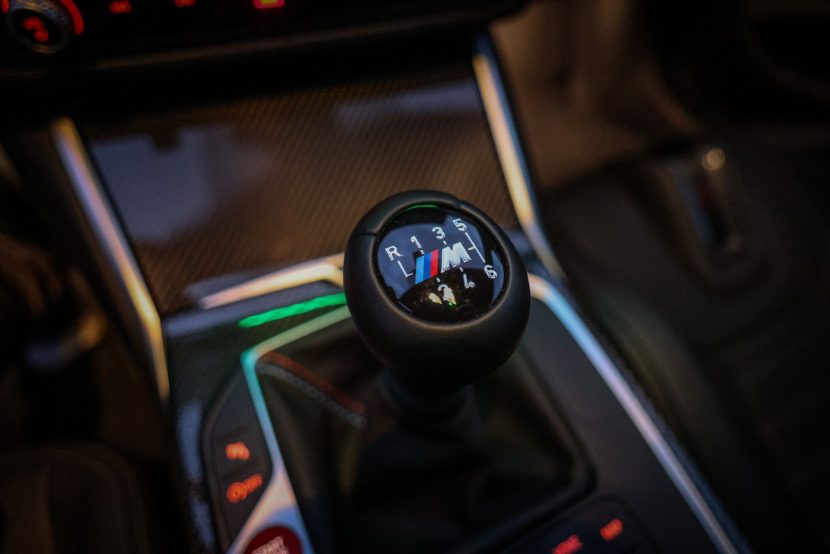
- BMW M is making efforts to extend the life of manual gearboxes to meet demand, especially in the United States.
- There are technical challenges M must overcome as manual transmissions are struggling to support ever-growing engine power.
- Besides manuals, BMW M is still investing in combustion engines.
The glory days of manual gearboxes are long gone. Today, the vast majority of performance cars come with only two pedals. It’s only a matter of time before the few remaining models that let drivers row their own gears disappear entirely. However, BMW M is holding tightly to its six-speed gearbox, as demand remains strong enough to justify the effort.
Even with an influx of electric Ms coming soon, the three-pedal setup isn’t going away just yet. Speaking with German business publication Automobilwoche, a senior BMW executive suggested the luxury brand isn’t ready to abandon manuals. According to Sylvia Neubauer, Vice President, Customer, Brand, and Sales at M, engineers are working around the clock to ensure that a manual transmission can handle the ever-increasing power output of combustion engines.
That’s encouraging, especially considering the M2 CS went automatic-only because the manual couldn’t handle the full output of its inline-six engine. Although BMW M hasn’t disclosed the workaround it’s developing, Automobilwoche reports that future M models with a manual could use detuned engines.

The technical limitations don’t necessarily stem from horsepower but rather from torque. As a reminder, the modern 3.0 CSL has the highest horsepower figure of any production BMW with an inline-six engine. Its twin-turbocharged 3.0-liter “S58” produces 553 hp, a record for a six-cylinder BMW. However, torque had to be limited to 550 Nm (404 lb-ft) so the manual transmission could handle the load. In other M models, the same engine can deliver an additional 100 Nm (74 lb-ft).
BMW developing an entirely new manual gearbox to handle higher torque is unrealistic, given that it would only use it in a handful of models. While demand remains relatively strong in the United States, BMW must think globally. The reality is that volumes are no longer sufficient, as buyers flock to automatic transmissions.
With the Z4 M40i going out of production, BMW is left with just three manual-equipped models: the M2, M3, and M4. And with a new 3 Series on the horizon, the current G80 is nearing the end of its lifecycle. We are skeptical that the next-generation G84 will retain a manual option. Then again, detuning the engine to preserve the manual could be a compromise some customers are willing to accept. However, it’s still too early to say whether BMW M will keep the clutch pedal alive.
Even if the next M3 goes automatic-only, the manual could soldier on at least until 2029. BMW is keeping the M2 and M4 in production for another three years or so, with the six-speed gearbox lasting until the very end. Before it disappears entirely, a proper send-off for the manual seems likely.
Neubauer also confirmed in the same interview that M remains committed to combustion engines. However, stricter emissions regulations are already limiting the potential of ICE powertrains. BMW has detuned the V8 inside the M5 and XM in Europe to comply with the upcoming Euro 7 standards. In recent years, BMW has had to reduce output in several models sold on the continent to meet tighter regulations.
It’s a constant “battle” between engineers and regulators, one that will only intensify in the years ahead. By 2030, automakers must cut fleet-wide emissions by 55% compared to 2021 levels, and by 90% by 2035.
Source: Automobilwoche (subscription required)